The original control
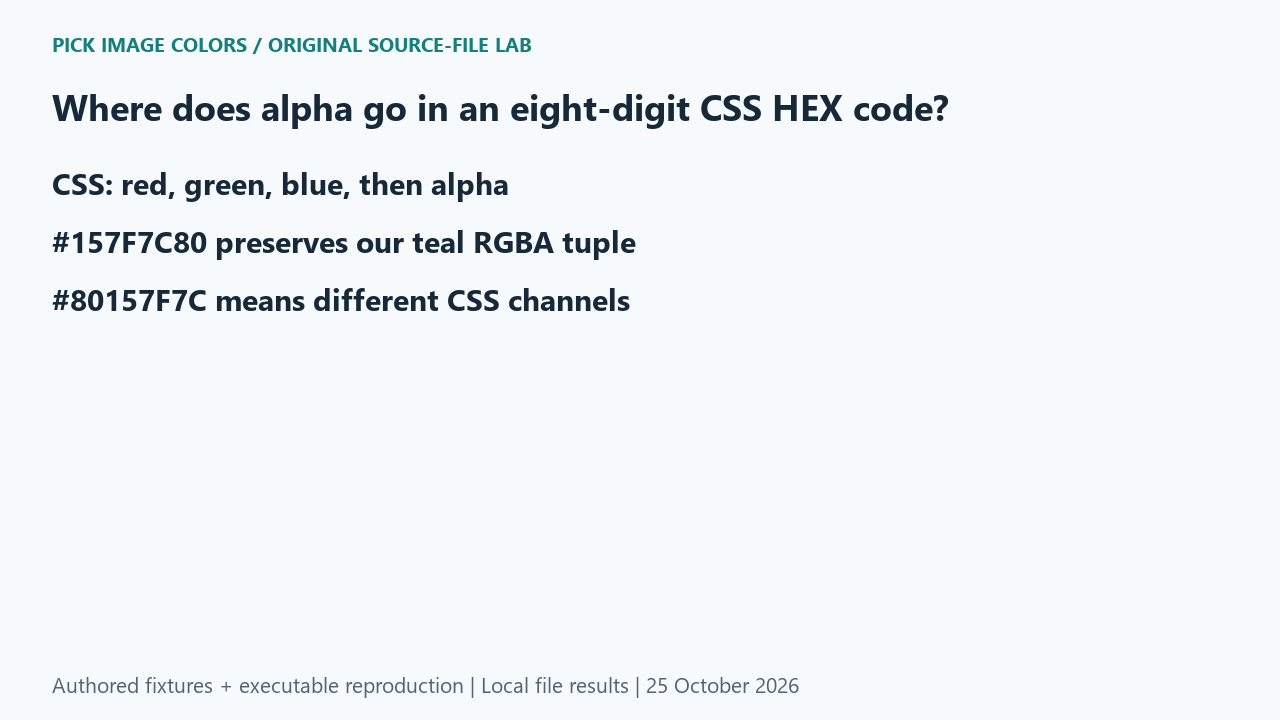
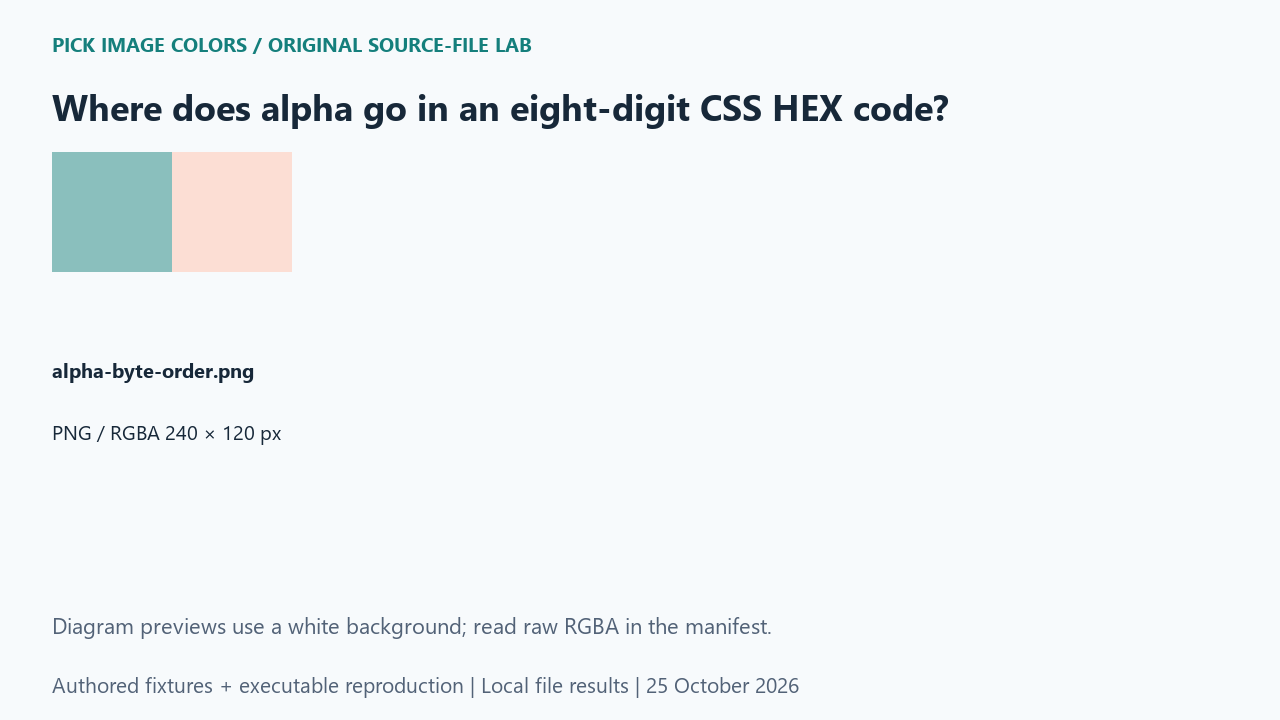
We authored an RGBA PNG with two equal-width swatches. The left stored (21, 127, 124, 128), and the right stored (244, 123, 82, 64). Our script serialized the bytes in CSS order and also constructed an alpha-first control string from the very same source channels. The PNG pixels themselves were not changed for the string comparison.
What the saved files measured
The teal source serialized as #157F7C80. The alpha-first control was #80157F7C, which reads as CSS channels (128, 21, 127, 124). The coral source serialized as #F47B5240; its alpha-first control #40F47B52 reads as (64, 244, 123, 82). The table records raw byte parsing, not visually estimated swatches.
| Original test file | Detected format / mode | Dimensions | Bytes | Distinct decoded RGBA values |
|---|---|---|---|---|
| alpha-byte-order.png | PNG / RGBA | 240 × 120 | 450 | 2 |

These are source-file measurements made with Python 3.12.14, Pillow 12.3.0 and libwebp 1.6.0. The manifest records complete file hashes, decoded RGBA hashes and the relevant coordinates. File sizes are measured bytes for these inputs, not forecasts for other images.
How to interpret this comparison
Checking only string length would miss this error: both representations contain eight hexadecimal digits. The receiving syntax decides which channel each pair means. We compare the full RGBA tuple so a changed alpha byte cannot hide behind a familiar-looking RGB prefix. The CSS specification confirms the last pair is alpha; the original test supplies the concrete channel examples.
Repeat this exact test
- Read the source RGBA samples and their css_hex strings in the experiment JSON.
- Split each alpha-first control into pairs and compare its CSS interpretation against the original tuple.
- Keep all eight digits when alpha matters. A six-digit HEX code alone cannot preserve that source alpha byte.
Download and unpack the ZIP. With Python and Pillow installed, run the command below. Compare the generated measurements.json with the included report. The script regenerates fixtures and computes the measurements; it does not obtain values from this article.
python reproduce.py --case css-eight-digit-hex-alpha --out rerunScope and limits
This is source-byte serialization and parsing, not a browser rendering test or a new export feature in the picker. Apparent appearance also depends on the background. We do not describe alpha 128 as an exactly half-opacity value.
Our own sample is a diagnostic control. Applying its conclusion to another file requires checking that file and the operations performed on it. We have not measured a global error rate or established that an automatic palette is an exhaustive list of image colors.
Can I identify byte order just because the code has eight digits?
No. Confirm the destination format. This page tests CSS order, with alpha at the end.
Watch the source-file comparison
Original diagrams and synthetic English narration. Caption sentence timings are approximate.